Monday, 23 November 2015

Demonstrating outstanding progress

Over the last two weeks, the Leadership Team in my school have done observations of every teacher. Each observation lasted 30 minutes and most of them were in the first part of the lesson. We are likely to be visited by either Santa, or OFSTED, or both this term and so we are very keen it show that our students make at least good progress in lessons. I have done 11 of the observations so far and have 2 more to go. In one lesson, I believe the students made outstanding progress, in all of the others it was good. This is all really positive but in all the good lessons I saw there were things that the teacher could have done, or provided that would have pushed the progress towards outstanding. I am about to feedback to all staff in 4 small Skill Sets sessions and these are the things that I have noticed some teachers do, or miss out that could make a huge difference.


If anyone else has other ideas to add I would be most grateful


Provide the data that shows the progress the students have made


All staff produced seating plans, annotated and with information on Pupil Premium, SEND, target grades and, where relevant, year 10 exam grades. This was all good and very useful but you can also show where they are right now by including a copy of your markbook. This shows exactly what progress students have made this academic year, shows the natural ups-and-downs of progress - and is something you already have done. If you photo copy it and put it in your blue folder once a month it will show a record of progress - and also prove how often you are marking. Once reports have been done for each group, print them off too and put in the folder. Don't take anything out of the folder, just add the new sheet in with a date on it. We have all this data - the blue folder can prove you are using it. A good observer will look in their books and folders too and who will see the progress there as well. This makes it easier for you to demonstrate it.


Check that all students are on task all of the time - and if they're not, do something about it


Most students are human. Most of the time they will pay attention to you and work hard in your lesson. But they will lose focus from time to time. If they are off task during an observed lesson, the observer will assume they are not making progress. I know some teachers are worried about telling off a student when they are being observed because they think it will reflect badly on them. Ignoring them and not getting them back on task is far worse. Every single teacher has had students not pay them attention - just watch teachers in the next INSET session and notice how often some of us check our phones, send emails, text, chat to the person next to us, do a bit of planning. Just like the kids, most teachers are human.


Don't allow any student to be off-the-hook at any time. Paired discussion before answering, tick and add


If you ask Joe "why was the Montgomery Bus Boycott significant?" you send 2 messages to the class. Firstly Joe panics because he has to think of an answer right now and, secondly, some of the rest of the class switch off because they are off-the-hook right now. This is between you and Joe. Try posing questions and give students time to discuss it in pairs. Be specific about what they are discussing and where it will go. "In pairs you have 30 seconds to come up with 3 ways in which the Montgomery Bus Boycott is significant. Write the 3 down in your exercise book". Now Joe has 30 seconds to work out an answer and everybody can contribute to the discussion. When you start to get answers from Joe, and others, don't let anyone off the hook. I often use a strategy of 'tick and add' - if they had thought of this too, tick it; if they hadn't, add it - and adding to their list demonstrates progress.


If you can't eat it, it shouldn't be on the plate


I remember John Torode on Masterchef berating a contestant once for presenting a dish with flowers on for decoration. His comment was "if you can't eat it, it shouldn't be on the plate". I think the same can be true of lesson observations. I have seen teachers tell students about literacy, numeracy, outdoor learning, careers in their subject etc during observations. All worthy stuff and I am glad it is happening, but sometimes it is completely irrelevant to the lesson at that point. It doesn't add anything and actually confuses some students because they can't work out why you are telling them this right now. A good observer will find evidence that you do all of these things in exercise books, on displays on the wall, in your blue folder or by talking to the kids.


Focus on fine detail to show rigour


One of the best things for me about this round of observations is that the vast majority of lessons where Key Stage 4. At this level, particularly with year 11, most students should be focusing on fine detail to make progress: looking at exam questions to determine exactly what they are being asked to do, interrogating markschemes to find out what the examiners reward, analysing examples of other students' work to see good practice. For the most able, this attention to detail is the best way for them to make progress. Don't be afraid to do this in an observed lesson even if it might be a bit dull compared to some lessons you might want to show off - but it is a great way of showing progress.


Routines prove that you are doing outstanding things day after day - lack of routine will expose that you aren't


The best lessons I saw in the last two weeks were lessons where there was a real sense of business-as-usual. You can spot routines in lessons. How students get into groups shows whether they regularly do this and understand how groups work well together. The presentation of work shows that they are routinely encouraged to work on that. How students respond to your questions shows whether they are used to hands-up on no-hands-up in your lesson.


Individual silent work allows each student to consolidate their learning, make sense of information and show their progress


Don't be afraid of short periods of silence in your lesson. Most students need a 5-10 minutes period of silent, independent work. This gives them a chance to consolidate the learning, make sense of what they have been doing, work out whether or not they really understand it - in short, to make progress. It also gives you an opportunity to move around and look at individuals. In my experience students don't mind working in silence - I often explain to them that they need to practice working in those conditions as these are the conditions they will have to work in during the exam. I use group and collaborative work in every lesson but I also have a silent, independent section of most lessons too.


You are in charge of the lesson - the observer is your guest. Show them what you want them to see


This is your room and these are your students. You know them, and the progress they have made better than any observer ever will. Produce a context sheet which explains what they have been doing in recent lessons, why you have arranged the room in this way. Put things in front of an observer that you want them to see. If you have great examples of their work in folders, put it in front of them. It doesn't guarantee they will look at it, but if it isn't there they will never see it.


One at a time


This was one of the best pieces of advice I have ever been given on teaching. When giving students instructions, give them one at a time. We have all done it, I suspect. In our rush to get them into a task we tell them what they are going to do, what they will need, what they will need next, what they will write after that and then which page they will look at next. Without realising it, we have given students over 10 separate instructions. They will probably remember the first one or two and possibly the last one - the rest are a blurry mess. Give them one instruction, let them do it, then give them the next one. It is quicker, they can all usually manage it and, confused kids can't show progress.

Monday, 13 July 2015

Webs of change

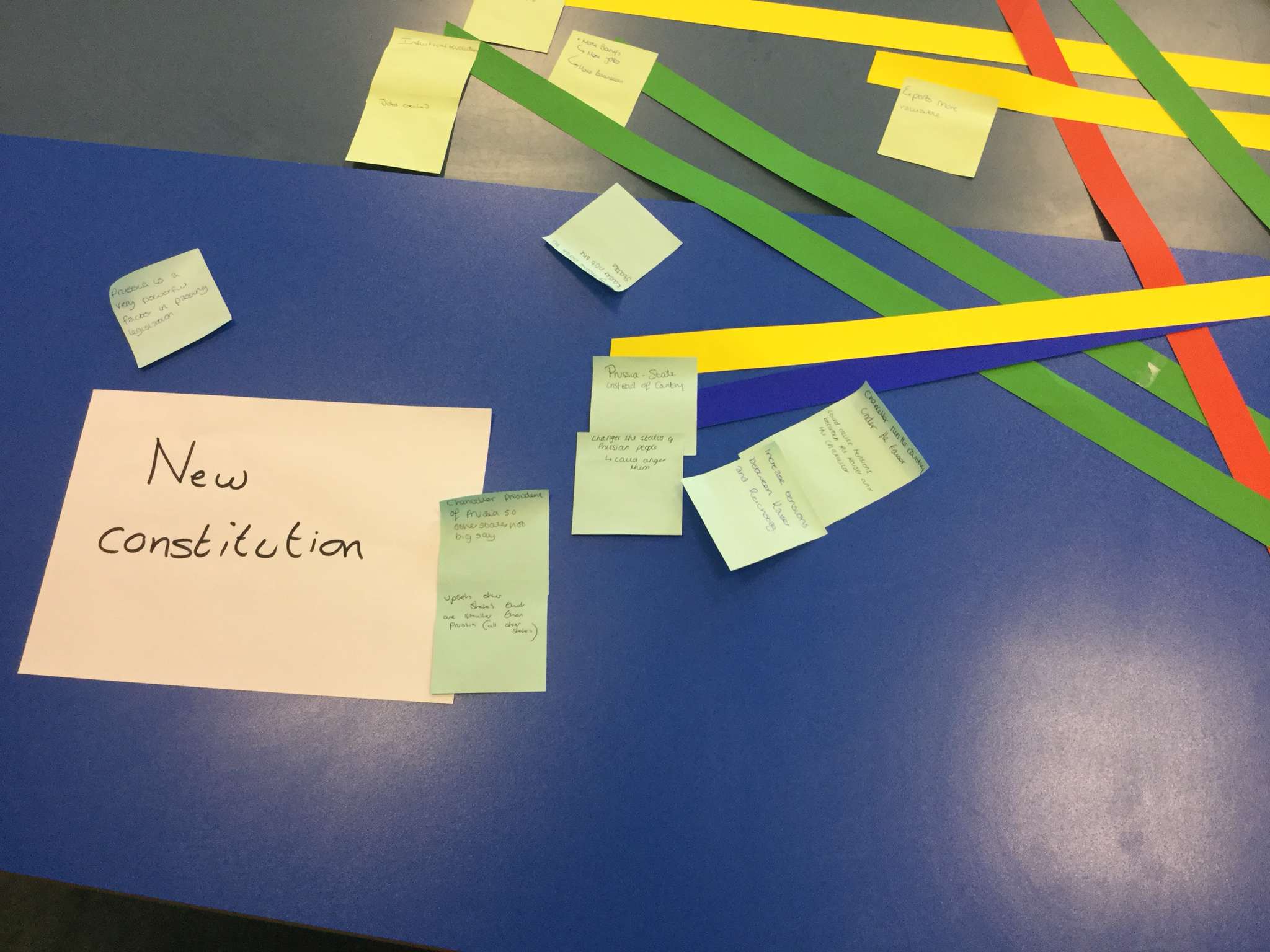
I was quite pleased with today's year 12 lesson. We were looking at the huge number of changes in Germany between 1870 and 1914. In 4 pairs, I gave them 4 big changes - new federal structure, new constitution, economic expansion, population growth - and a set of post it notes. They had 2 minutes to think of as many changes as they could which resulted from their big change. They put each change on a separate post it note. After 2 minutes they rotated groups and either added more changes on fresh post it notes, or added a change to a change - attaching a post it note to another post it note. They then rotated around until they had looked at each change.

They then moved their original big change and post it notes to a big table and arranged them in 4 areas. I gave each pair some coloured strips of paper and asked them to make links or chains between different changes.

We then sat around the table discussing what they saw. They were able to talk about most significant changes, long and short term change, which changes would cause tensions an how German people might feel faced with so many changes.

I was really impressed by the depth of their discussion and the level at which they were thinking about the effects of change. This activity really helped them to appreciate the complexity of change and how effects link together.

I then asked them to do their own version of this diagram. This was unexpectedly effective as they approached it in so many different ways. Some produced colourful versions of it, one did a mind map and one of my mathematicians decided on a vent diagram to show how so many changes overlapped. The next step will be to compare the diagrams to see how they differ and then get them to do a piece of writing based on what were the main tensions in Wilhelmine Germany. Not bad for 5 days from the end of the school year


Saturday, 11 July 2015

Ten Keys to a great lesson

I have been working on this as guide to give to staff in September. It is still a work in progress so feedback would be great


Ten key non-negotiables. This is the least our students and any visitors to our classrooms should expect


1. Student Place. In the blue folder, up-to-date and clearly annotated to show Pupil Premium students, why they are PP, target grade and current working grade. It should clearly be a working document


2. Feedback and use of DIRT. Students work should be marked at least every 3 lessons. The marking and feedback should be subject-specific and designed to help the student move forward. DIRT activities should be clearly labelled and it should be clear when and how the student has attempted to improve their work


3. Progress over time - make sure there is evidence available to show how much progress students have made over time. This could be in their existing exercise books or in previous books or folders stored in the classroom. This should be designed to primarily show the student how much progress they have made in this subject and what they are aiming for


4. Appropriate range and pace of activities. There should be a variety of activities used in the lesson. Opportunities for collaborative work, teacher talk, quiet independent study. It is the teachers responsibility to make sure there is the right balance between activities. Every 20 minutes at most - ask yourself is this still the right activity?


5. Challenge. Activities should be differentiated so that every student is stretched to achieve more in the lesson


6. Variety of student interactions. During the lesson students should have the opportunity to interact with the teacher directly and with each other, in pairs or in groups


7. Learning checked and assessed. Think about how you will check and assess how much students have learned during the lesson.


8. Homework set and used effectively. All staff and students will be using Show My Homework. If homework is due in this lesson- when will it be collected? If homework is to be set this lesson - when will it be on Show My Homework?


9. High quality presentation of work. The quality of students' presentation of work is an indicator of their attitude to the subject and their learning. Set high standards of presentation for all work done in folders or exercise books. Model the standard expected by giving students high quality resources - sheets, PowerPoints - to work with. This high quality is an indication of all of our high expectations and aspirations.


10. Active engagement. All students should be engaged in the lesson. Keep looking for students who have drifted away - how will you re-engage them?


Wednesday, 8 July 2015

Starting early


I had an idea that may make me very unpopular with some staff and some students - starting year 12 early. We work year 11 like crazy and get them, hopefully finely tuned and firing on all cylinders by the end of May - and then give them 3 months off. 3 months in which they do recharge batteries, but also get out of good habits, get bored, get lazy and get used to being lazy.

So my idea is to bring them in for 3 weeks in mid-June to early July. Use teachers year13 timetable to provide the teaching slots, build in some team-building, study skill activities and teach some if the background stuff to A Level history that is vitally important but takes up time in September.

The members of CLT I have spoken to like it so I now have to get it through a few more people but it might give students a chance to try out some courses, allow us to set more meaningful summer assignments and convince those who see school sixth-forms as too soft that we do challenge and stretch our students

Wednesday, 19 March 2014

Do we need to actually see it?

Do we need to actually see it?

I am writing this post in 2 parts and will post it on line some time in the next couple of days. Right now it is 10:56 local time on Tuesday 18 March and I am sitting on a coach outside Krakow Airport. In a little while we will be at Auschwitz-Birkenau concentration camp. I am on a 1-day trip with 2 yr12 students as part of the a Lessons From Auschwitz project. At 47 years old I have just had my first plane flight and, apart from 6 hours in France 20 years ago, this is my first trip abroad.
As a History teacher I have taught about the Holocaust for many years and found it to be one of the most intersting topics of the year. Unlike many history teachers I have not done many trips - a few local castles or 1-day trips to the Black Country Museum, but I have never done the Battlefields or Auschwitz before. I have always had mixed feelings about them. I have always felt that I can understand the horrors of the Somme or Auschwitz without actually being there - or was that my excuse for not going through the laborious, time consuming and stressful experience of organising the trip?
Today will give me the answer. I am excited, curious and apprehensive all at the same time. Later on during the day I will record my feelings - now it is time to catch up with a bit of sleep. 2:45 am is a very early start.

So now it is 7:52pm GMT and I am on the plane back home. How do you describe today? I know it will be the first thing colleagues and students will ask tomorrow - how was it? Right now I'm not sure what to say. I know Auschwitz will play with my emotions for the next few days. Auschwitz is a full- on assault on the senses. Every time you see, hear or feel something awful you turn a corner and get ht by something else.
Auschwitz was nothing like I imagined. In my head I had always pictured it as somewhere remote and isolated but it us in the middle of a town surrounded by roads, shops and residential areas. How could such unbelievable inhumanity go on so close to where people were eating, shopping and living relatively normal lives? At times Auschwitz felt a bit too much of a tourist attraction. The guides are good but moved us around at such a pace it was overwhelming. Often I wanted to stop and look longer at particular exhibits or reflect on what was there but the next group was always hot on your heels. There were points though that will stay with me and haunt me: the heartbreaking piles of hair and shoes, the luggage so carefully, lovingly, proudly labelled but with no hope of ever being returned, one long corridor with cells leading off but hundreds of photographs of victims silently watching us and we walked the corridors where they died and of course the gas chamber itself. It is so hard right now to describe how it felt to walk in and, more poignantly walk out of there.
But for me Auschitz II - Birkenau was more horrific, heartbreaking and impactful. The sheer size of the site, the mind-boggling absurdity of there being a football pitch there and walking along the 'Road to Heaven' - the route that thousands took to the gas chamber. I will never forget the powerful, heart-rending service we all took part in near the memorial in the shadow of the ruins of the gas chamber. We all lit candles and placed them on the memorial or on the train track - a symbol of hope, memory and defiance.
So - do we all need to go to places like Auschwitz? No - it is perfectly possible to have a strong, powerful response to and understanding of the Holocaust without ever leaving the classroom. But - if you do go, it will change your life. Auschwitz will now always be a part of me now. Every time I teach it I will think of today and how it affected me.
The Holocaust Educational Trust do a staggering job. They are making sure that young people not only know about Auschwitz but will tell others about it. I am 47 years old. I have another 21 years ahead of me in teaching. I have to keep teaching now. I have to tell more children about this. If I don't then I am letting down the ghosts I saw and felt today.


- Posted using BlogPress from my iPad

Sunday, 8 December 2013

Structured Collaboration

Two weeks ago I attended an INSET day on Kagan structures. I wrote then that I had been impressed and was keen to try out some of the strategies. I have always been a huge fan of collaborative learning but have been bowled over by the improvement these strategies have made to the quality of the students' learning.
The main strategies I have used have been Rally Robin, Timed Pair Share and Write Rally Robin. All of these are similar to strategies I have used in the past but the structure here forces students to play a full part in the whole process rather than let someone else do all the work.
Rally Robin - students take it in turns to say word on a topic is a great starter and surprisingly hard. On most occasions I have played too and I would recommend always trying to get involved in all the collaborative games you are playing.
Timed Pair Share I really like as students have 30 seconds to talk about something to their partner - their partner then paraphrases what they said. This is great for reinforcement and making the partner actually pay attention. I have thrown in a variation where the partner has to add something the speaker forgot. I find you need some variations to the formula to keep the kids on their toes.
Write Rally Robin is a brilliant way to build and develop the ideas students produce in groups. Students have a few minutes to work on a task. They then feedback to the group or the whole class - the other students tick it off if they thought of it and add it if they hadn't - a great way to make sure they all are involved.
I have used these techniques with all groups but they have been particularly successful with my Sixth Form groups. My year 13 group is only 4 students who are all naturally quiet so this has really helped structure and develop their discussion.
I am very impressed at how some really simple extra touches have made such a difference to my lessons. Looks like I may be adding the Kagan book to my Xmas wish list. At the INSET session some teachers were a bit skeptical and thought this was all too simplistic and silly. I hope they give these ideas a try - I am glad I did.


- Posted using BlogPress from my iPad

Saturday, 23 November 2013

Long week and new ideas

That was a really hard and long week. Lots of late meetings, Sixth Form open evening, after-school revision sessions and an INSET session. I wonder if there is any other job quite like teaching for throwing those kind of crazy weeks at you and knowing that next week will only be slightly less intense.
My lessons this week have been ok - not my best but some unexpected high points. A year 13 lesson on Germany in 1919 developed into an in-depth discussion of the merits and faults of democracy with the students showing admirable insight and perception.
The real highlight for me was an INSET day led by Elaine Brown from T2Tuk on Kagan Structures. I have to admit to being a little sceptical going in to this. I am a huge advocate of collaborative learning and students work in pairs, threes or other groups in virtually every lesson I teach. Rather arrogantly I went into the day thinking I had probably seen most of what would be presented. I was wrong. Whilst some of the ideas and techniques are already in my toolkit, most were slightly different or completely new. More importantly the ones that were slightly different were better than what I already do.
On Monday I will definitely be using Rally Robin, Timed Pair Share and Write Round Robin. I also appreciated that the presenter took the time to explain the psychology and pedagogy around the techniques she was using. This was more than just a bag of tips session.
It is testament to the quality of the session that at the end of a manic week I felt inspired and looking forward to Monday's lesson.
One other thing did strike me this week and that is that I am now being seen by others as a 'veteran' - and I think that scares me. I realised on Monday that on our College Leadership Team there are only 2 of us who had experience of teaching pre National Curriculum. During Friday' INSET one way of randomising groups was to create a line of experience. We had to arrange ourselves in a line around the room based on number of years teaching x number of schools worked in. Out of 100 people only 3 had a higher number than me - 23 years x 5 schools = 115. The only consolation is that in Gravity the role of the veteran is played by George Clooney - at last we have something in common.
Roll on next week


- Posted using BlogPress from my iPad

Saturday, 16 November 2013

Open Invites and the best test of the year

Some real highlights this week. My Year 11s are currently preparing for their Controlled Assessment on the Civil Rights Movement in the USA. Whilst trawling through the internet last weekend (a poor excuse for not really doing any work) I cam across a fantastic resource - a scan of the literacy test used in Louisiana in the 1960s to stop black people from registering to vote. I typed it up so it looked a bit more like the kind of test they are used to and gave them it cold at the beginning of the lesson. They had 10 minutes to complete it and had to get all 23 questions right to pass. Every single student failed including several who are targeted A*. The best thing was how annoyed they were at the test - the questions weren't that hard but they were badly worded, vague and in some cases - just weird. This is just one example:

15. In the space below, write the word "noise" backwards and place a dot over what would be its second letter should it have been written forwards

And it was fascinating to see how many got "spell backwards, forwards" wrong.
The test was great for helping students to understand why so few blacks were registered to vote in the 1960s.

This week I have introduced a new idea at school called Open Invites - asking staff to nominate some of their lessons where they are happy for anyone to pop in and observe for 15 minutes. Three of us volunteered lessons this week and several teachers popped in. I have to admit it really made me raise my game knowing that anytime someone could appear and expect to see something good - like OFSTED but without the fear. The lessons that were observed went well and I got some good useful feedback. The next step is to persuade more staff to offer up invites and to give up a bit of time to go and watch.

I also got back into podcasts this week by putting some revision podcasts on Emdodo for year 11 (and 25/39 turned up for revision lesson on Wednesday - hurray!). Year 13 also recorded their own podcasts on the effect of World War One on Germany. I am now thinking about doing some video podcasts on YouTube if I can find a few minutes.

Busy week coming up - looking forward to leading an INSET session on Assessment, marking and feedback on Wednesday, looking at how the Nazis used emotion to gain support and attending an INSET day on Kagan structures on Friday.

And I managed to blog two weeks in a row :)


- Posted using BlogPress from my iPad

Saturday, 9 November 2013

Revisiting, reviewing, reinvigorated

This is my first blog entry in ages and is inspired by a fantastic Teachmeet I attended on Thursday. Two of our young MFL teachers invited me to go to an MFL Teachmeet. I have to admit that I felt just a little apprehensive at the start - not only was I the only one who wasn't a languages teacher but it was also in the uncharted waters of Plymouth! I really was a fish out of water but quickly settled into a great evening of ideas and creativity. What is it about TeachMeets that can keep a room full of teachers interested and involved at 7.30 at night in early November?
All of the presentations were excellent and almost all of the ideas could be easily transferred to my History classroom. One of the things that struck me was that most of the ideas weren't new - lots of them were things I have done before but for some reason I have stopped doing (blogging being just 1 example). I didn't mean that to sound arrogant -as I have always said, I don't think I have ever had an original idea. I am just quite good at nicking stuff and converting it for my classroom. Over the last couple of days I have been flicking back through old lesson plans and folders for stuff I used to do and shouldn't have stopped. I used to always start lessons with an image and they were brilliant for generating interest and questions and I haven't done it in ages - but they will certainly be making a comeback next week.
The excellent Ben Rowe (@itsmerowey) from Saltash reminded me of the value of regular blogging. He recommended using it as a way to reflect on each week's teaching and I think that's a great idea. So I have dusted off Blogpress and hope/aim to post each week with some reflection on my lessons. Perhaps it's because I have stopped blogging and reflecting that I have stopped doing some of the things that worked best.
So this week has been a pretty good one - not brilliant but some good stuff. I do think I have been too content heavy though which has led to lessons being a bit dry.
Year 13 have had their first go at a historical controversy question on Germany's responsibility for World War One and I am very impressed at their research for coursework.
Year 12 have been looking at the rise of Sinn Fein and using the mini IPads for research. I still don't feel I have quite cracked using the IPads in the lessons yet though - they are part novelty and part distraction at the moment so I do need to think through how I am going to get the best out of them.
Year 11 are getting close to being ready for their Controlled Assessment and Year 10 are just getting to groups with Nazi Germany.

I am really looking forward to this week though. I have just found a copy of the literacy test which the state of Louisiana used to stop blacks qualifying to vote in the 1960's - I am going to get year 11 to try it on Monday to see if any of them can pass it. I don't rate their chances.
I am also doing one of my favourite lessons with year 10 which mixes Adolf Hitler, Derren Brown and NLP.

Also this week I am introducing Open Invites - so far 3 teachers have nominated several lessons this week that are open to anyone to pop into and observe. I just now have to convince some people to go and watch.

Hopefully, I will blog next week to reflect on it all.


- Posted using BlogPress from my iPad

Tuesday, 21 May 2013

The rhythm of a lesson


Recently I have been watching a lot of lessons, particularly in Music, and also teaching a lot (even Assistant Heads teach a lot of lessons these days) and was thinking the other day about the natural rhythm of a lesson.
A really good lesson has a lot in common with a great piece of music. I was teaching year 10 today about the Cuban Missile Crisis and, as usual, used it as an excuse to play some of my favourite early 60's music - Sam Cooke, Andy Williams, James Brown, Marvin Gaye and a touch of Elvis. The best lessons start with a great opening which grabs the attention, hooks the kids in and maybe even catches them by surprise - think about the opening to Heartbreak Hotel.
There is often then a natural uptempo beat to the early part of the lesson where the teacher introduces the topic, skilfully draws in every single student to speak at least once in the 1st 10 minutes with focused questioning an answering.
As the 1st activity of the lesson kicks in a new louder beat takes over as students work with each other, talk, exchange ideas and settle into the pace of a new activity. This is where he really good teacher is like a songwriter or maybe a conductor - they know the importance of pausing and skipping a beat, introducing the breaks at just the right time to bring the students back to the focus of the lesson and make sure that some groups don't drown out the others.
The next section of the great song/lesson has similarities to he earlier part but is noticeably different. It may be a different voice or instrument - in the lesson it could be working with different students or in a different medium, writing instead of talking, turning ideas into images. In a song the chorus with the hook line or beat kicks in every now and again - in the great lesson the teacher keeps bringing it back to the focus of the lesson, the key question or progress target.
I guess the big difference, and where my increasingly stretched metaphor falls apart, is my belief that just about every lesson should have a period of quiet individual focus where the students work on their own, summarising, creating and making sense of the lesson. Too often I think this is the bit that gets missed out of lessons and yet I believe it is crucially important to check each students own level of understanding.
And what about the end of the lesson? I must admit I have never been a fan of the song which just fades away and I love a big finish. The best lessons I have ever seen finish with something new or surprising - perhaps a hint of what is to come next time.
The other similarity I guess is that great songs stick in your mind and you remember it for years singing to yourself. The great lessons can be just as memorable.
The playlist from today's Cuban Missile Crisis lesson was:
Wonderful World, Sam Cooke (how can I resist a song which starts "Don't know much about History"
Music to watch Girls By, Andy Williams
Chain Gang, Sam Cooke
Stuck on You, Elvis Presley,
Nowhere to Run, Martha Reeves and the Vandellas
Can I Get A Witness, Marvin Gaye
Danger Heartbreak Dead Ahead, The Marvelettes
Hit The Road Jack, Ray Charles,
Trouble, Elvis Presley
James Bond theme, John Barry

- Posted using BlogPress from my iPad

Thursday, 21 February 2013

Collaborative Learning

Next Monday I am leading a whole staff INSET on collaborative learning. This blog is really about me getting my ideas together for the introductory session which will set out the case for collaborative learning.

I may as well set my cards out on the table right at the start. I am a fan of collaborative learning. I use it virtually every lesson with every year group and have done for as long as I can remember. To me it is one of the basic ingredients of every lesson plan and is my default setting for all student activities. Organising an INSET day on collaborative learning has been really useful to me because it has made me stop and think about what it is and why I use it - and to question whether just because I do it does that mean it was the right strategy?

Let's get the definition bit out of the way first. I prefer the title "collaborative learning" over "group work" simply because group work to me implies at least 3 students working together. Collaborative learning, I believe, is when students work with at least 1 other person to develop their own learning - it is pairs, threes, fours, fives sixes, tens, half a class or even a whole class. What is a whole class if it isn't just a big group?

I believe the benefits of collaborative learning are huge. I want the students in my classroom to do far more work than me. Me leading from the front of the classroom can be a very passive process - any form of collaborative learning puts the emphasis on them doing something. I have always felt that students are far more likely to remember a lesson in which they were positively engaged and active; in which they said and did something. Collaborative learning increases the chances of them doing something and therefore remembering it - the point of the lesson. (I speak from personal experience - I can remember most of the meetings in which I have said something: there are hundreds in which I was passive, they washed over me whilst I waited for them to end). Often I will follow up any short input from me with a collaborative task which is aimed at allowing students to process what I have just said and check that they actually understood it.

Despite learning styles going out of fashion with some people, I still like it and believe in it. Auditory learners benefit enormously from collaborative learning as it gives them an opportunity to think out loud and hear their own ideas - an important step in their process of understanding and learning. Almost every teacher I have ever met has known that teaching something is the best way of learning it - collaborative learning gives our students a way to experience that.

Some people have said that they haven't got time to do collaborative learning because there is too much content to get through. Personally I have always found that I can get through more content this way - particularly some of the dull stuff (I know that may come as a bit of a shock to find out that even history has some dull bits in it - League of Nations still makes my heart sink every year). Collaborative activities like Home and Away groups, Market Place and World Cafe (my 3 go-to collaborative activities) allow you to get through far more content because groups of students research different aspects and feedback to other students. They sort out the key bits of information for you.

In my new role as an Assistant Headteacher for Teaching and Learning I find that I now do a lot more lesson observations. Collaborative learning is great from an observer's point of view because it gives me an opportunity to actually talk to kids. I can talk to small groups without interrupting or distracting the teacher, ask about targets and previous lessons and have a quick look through books. Any teacher who is looking to get outstanding on a lesson observation will want the observer to talk to the kids - collaborative learning lets this happen. It also makes it much easier for the teacher to show differentiation and how much progress students have made - again key criteria for getting that "Outstanding" tick.

Fear about behaviour management often comes up as one of the main reasons some teachers have for not using collaborative learning. Again I have always used it as a behaviour management tool. Splitting students up into small groups makes it easier to identify who is actually misbehaving. Often I will move students into groups simply to break up 1 group of students without a confrontation. It also makes it a lot easier to have a quiet word of warning with some and encouragement with others.

I believe that as teachers we have a duty to develop our students' skills in collaborative learning - they will need to be able to do this in the future. Even with new technology most careers require us to be able to collaborate with other people and know how to share ideas and improve them. Personally I think that many of us secondary school teachers are the weak link in this process. As an AST I had the pleasure of going into a lot of primary school classrooms and in almost all of them collaborative learning was the norm. It was deeply entrenched in the day-to-day routine of the students and they are highly skilled at it - a huge compliment to their teachers who have put in hours of groundwork to develop this. For many students arriving in Year 7 we send some strange messages about how we expect 'older, more mature' students to work and behave. We put them in rows (do any primary school classrooms work in rows?) and have them facing us - are we not sending a huge message that they have grown out of group work? That's what they did when they were little. I know I am generalising here but I wonder if there is some truth to this. Year 7 students are very keen to fit in with their new school, new environments and new friends - many of them seem to forget how they worked so successfully in Year 6. But I suspect many secondary school teachers encourage them, perhaps unconsciously, to forget. I have heard some teachers at my school say that some of our students lack the social skills to do group work. I don't believe that is true. I have used collaborative learning since my 1st day at the school in September and haven't had to do anything special with the students. They have worked in groups as well as any students I have worked with - even ones I have 'trained'. And if it is true that some of our students lack the social skills - they are never going to develop those skills by not working on groups.

The key to successful collaborative learning for me is to be clear and specific about what is happening. I always select the groups - sometimes by random numbering, sometimes by subtle ability groups. I always make it extremely clear what the task is that the group has to do and what role(s) each member of the group has. I make sure that there is something for everyone in the group to do. I make it clear how long they have to complete the task. I move around every group quickly in the first few minutes to check everyone knows what they are doing. I stop them all to check progress or give new instructions. I randomise feedback so everyone in the group has the responsibility of representing the group. Collaborative learning might mean they are doing the work - but it is also the time when I am busiest.

There are of course times when collaborative learning is not appropriate. I am equally in favour of students becoming independent learners - in fact I believe the two states are fundamentally linked. A good independent learner knows the value of collaboration. Almost all collaborative tasks begin with a minute or 2 of independent work so that every students has at least 1 thing to contribute - otherwise the loudest student tends to dominate. I often end collaborative learning tasks with individual time so that students have the opportunity to make their own sense of what they have just done. To me collaborative learning and independent learning are part of the same process.

So those are my thoughts on collaborative learning. I have to say I am looking forward to Monday's INSET because I am hoping to pick up some new ideas from other staff for group work. Although I use collaborative learning a lot I do have a stock 3-4 strategies that I probably over-use. I am also nervous about it - I know there will be some resistance and not every one will like how I have set out the day. I do aim to make the sessions as active as possible and to smuggle as many collaborative activities in as I can - and I have ordered some nice pastries for break time. Now it's time to finish off the resources and PowerPoints - I think I have at least worked out my own thinking on collaborative learning. I will let you know how it goes.
- Posted using BlogPress from my iPad

Friday, 2 November 2012

How to get Good in a lesson observation

In my new role as Assistant Head I have done a lot of lesson observations lately and they haves been brilliant. My Head has asked me to put together some advice for staff on how to teach a lesson that can safely be judged as Good. This is my first draft and is based on some of the things I have seen in the last half-term. I would be very grateful if any of the wonderful teachers who occasionally stumble upon my ramblings could read it and make suggestions. What have I missed? I know there will be lots as this is vey much a first-stab at this. I look forward to lots of your comments.

How to teach a Good lesson

Preparation
Give the observer a seating plan which is annotated to show student targets and current level of progress. The best ones also have comments about particular students, i.e. "very quiet but making good progress with group activities". This shows the observer that you know the students well. You do not have to produce a lesson plan but for a planned lesson observation you might want to. The lesson plan could be your opportunity to explain the context for this lesson, work covered already or, particularly if this is a 30-minute observation, let the observer know what will happen in the second part of the lesson which they will not see. The lesson plan could also be useful if this lesson comes at the wrong time to show off your skills at group work or active learning because they have to do Controlled Assessment today or the exam is tomorrow.

Starter
In a good lesson, students are learning from the moment they arrive at the lesson. Meet and greet them at the door - this shows you know them and have a good relationship with them. It can also get minor behaviour issues such as earphones and wearing a coat out of the way before they come in.
The starter activity can be on the board or screen - if you know the class always arrives in dribs and drabs for this lesson because they come from different places, you might want to do a settling starter that each student can get onto individually as they arrive. Activities like asking students to draw a brain (or head) and fill it with words used last lesson work well for this.
In a good lesson students need to be making progress. Make sure you let them do things to show that progress. It is extremely difficult to show they have made any progress if they have spent a lot of the lesson sitting listening to you. Explain what the lesson is about and their progress targets - but do it quickly. The information can be on a PowerPoint slide or on a handout to go back to but don't spend 10 minutes telling them about it.

Pace and Progress
Structure the lesson around a series of activities. Although it may have been discredited by some educational experts and thinkers, I still use the idea of concentration span as age in minutes + 2 minutes as a pretty good guide for how long to make an activity last. It is a very good idea to stop any activity after around 12-15 minutes at most. In an observed lesson you may want to make a quick stop after around 6 minutes to just check they are all on task.
With any activity check the 3 T's - Task, Team and Time. Explain exactly what the task is, tell them whether this is individual, paired or larger group and exactly how much time they have. Keep the instructions for the task to a minimum. There is no point in giving them a long list of instructions as they will have lost you by about the 2nd or 3rd one. Give them 1-2 instructions to get started and then use a brief stop a few minutes later to give the next instruction.
If working in groups, put them in the groups yourself. If you allow them to choose their own groups you are inviting questions, discussion and negotiation which at best will delay them starting on the task and at worst lead to students challenging you. Students rarely complain about groupings if they know it is for a specific reason and a short period of time. Group work is best when it is something that students are used to and have done with you many times. It is dangerous to do anything in an observed lesson you have never done before. Use group work often so that students are familiar with it, with you and in your room.
An observer will want to walk around and have a look at what students are doing. They want to ask them questions and probably look in their exercise books. Group work gives them an opportunity to do this. It also gives you a chance to show how good you are at working with students in smaller groups and individually. Get around to every group and speak to them. Check they understand the instruction, answer any questions they may have, encourage those that haven't quite got round to starting yet and ask them about the work they have done. These question-and-answer sessions are another good way of showing how much progress they have made in the lesson. Publicly praise groups or individuals who have completed tasks, asked a great question or done something interesting.

Feedback
Make an opportunity for students to give feedback to you and/or each other. Stop activities and do quick question-and-answer sessions. Use these sessions to stretch the most able students. Push them with your questioning and explain what is required at the highest levels or grades.

Showing progress
One of the key criteria now for judging lessons is whether students made progress during the lesson. This can be very difficult in a 30-minute observation but there are strategies which might show it. The Dump Test or Pages of Progress is one way. This is simply a sheet of paper or a page in the back of the exercise book. At the start of the lesson ask students to write down in just 60 seconds anything they know about a topic. 10 or 15 minutes later, revisit the paper and add in as much as possible in 60 seconds in a different colour - a simple, visible and measurable record of progress. Later sessions can ask students to make links between words or ideas. Another way of showing progress is to have a list of questions posed either by you or by the students on the wall or board and stop occasionally to ask students which ones they can answer now. I observed a lesson once where students were given a C grade exam answer to look at and at different stages in the lesson asked to add things to it to turn it into a B and then an A grade answer.

Key points for a good lesson:
Let the students do the work - most of the lesson should involve them doing things
Allow students to interact with each other - create opportunities for them to talk to each other and feedback to each other
Short focused tasks - if any one activity is going to last more than 15 minutes make sure there is a really good reason for it
Allow the students to show that they have made some progress in the lesson
Every student in the room needs to be engaged and part of the lesson - it is part of your job to make that happen
Don't talk for long periods of the lesson - focus on teaching the lesson rather than trying to show the observer something
Aim to do all of these things every lesson and they will work better in an observed lesson. Students will do them naturally because they are used to them, you will be more confident in doing them and an observer may ask students if this is typical. So be careful if you have never done group work and throw it into an observed lesson!


- Posted using BlogPress from my iPad

Location:Queen's Crescent,Bodmin,United Kingdom

Thursday, 10 May 2012

The Big Red Ball of Wool

I came up with this idea a few weeks ago and recently tried it out with my 2 GCSE groups. The results were really encouraging, particularly in engaging the kids - and all you need is a big ball of red wool.
I got the students to sit in a big circle - I also sat in the circle. The aim was to get the students to think of links between different historical events and people and see how they influenced each other. I chose the topic. With my yr 11 group it was Votes for Women, my Yr 10 s had the Cold War. I started off by naming an event or idea. I then threw the big red ball of wool to a student across the circle whilst keeping tight hold of the end of the wool. The student had to then name another event/person/idea and explain how it was linked to my word. They then threw the ball on to another student, keeping hold of their end of the wool - the next student had to say something else and explain how it was linked. This was great fun - the students had to think quickly and, at times out of the box. By the time we reached the last student we had created a striking visual - a red web of wool linking each student together and each idea together. I knew it was a hit when several kids asked if they could get their phones out so they could take a photo of it because it looked so cool.
We then reversed the whole process with each student throwing the wool back and winding it up as we went, this time they asked each other quiz questions.
A really good revision exercise or plenary - but one which also encourages kids to make links, one of the higher order thinking skills which gets them a lot of marks in the exam - and more importantly had them talking about the lesson in the corridor afterwards.

- Posted using BlogPress from my iPad


Monday, 7 May 2012

New job and new opportunities

The last week has proved just how little I know. In my last post I wrote about how I was not hopeful about getting a job I had just interviewed for. This week, to my delight and surprise I found out I had got the job and from September I will be an Assistant Head for Teaching and Learning.
I am really excited about this new opportunity and can't wait to get started. I have a 1,000 things I want to do and will spend a lot of time over the next few weeks deciding how to approach my new role. The key thing for me is that this job is about improving teaching and learning. I get to work with teachers and students to be at the forefront of new ideas and strategies. I want to encourage teachers to take risks and try out new things - especially when they are not sure if they will work.
I am also looking forward to watching lots of new teachers at work in their classrooms - and steal ideas from them as often as possible, as I have always done. Expect to see lots of those ideas on this blog in the future. I am sure I will make loads of mistakes and there will be some tough times ahead but I am absolutely convinced this is the right move for me - and that I am the right person for this school.


- Posted using BlogPress from my iPad

Saturday, 28 April 2012

Learning from Experience


I had my 1st interview for an Assistant Head post this week and it was my first real interview for anything in 12 years - and it has been a long time since I played this game. I won't find out the result until early next week but I am not hopeful. The day wasn't a disaster but I know I didn't do as well as I could have. I am disappointed about this because I really liked the school and felt that I could do a good job there.
The experience has made me realise that I do want to be an Assistant Head - something I have fought against for a long time. I do believe I have something to offer School Leadership because I am passionate about teaching and learning being the 1st and last priority in schools.
I have also learned from this experience that I need to prepare more thoroughly for interviews and spend more time planning how to answer interview questions. Whilst most of the day went well, I wasn't happy with how I performed in the final interview. I tended to answer questions too quickly without really thinking them through and not explain my thoughts in enough detail.
I am determined to learn from this experience. I have tried to write down every question I can remember being asked so I can start to build up a bank of them and will continue to apply for jobs - but I do now fully realise j it's how much I am going I have to raise my game.

- Posted using BlogPress from my iPad

Sunday, 5 February 2012

Recreating the Past

Oops - suddenly realised I just went through the whole of January without blogging.  Sorry - been a busy month.
The real highlight of this month was undoubtedly a workshop I was involved in for Yr 11 GCSE History students.  They are just starting the OCR Depth Study Unit on Britain 1890-1918 - the Paper 2 unit which they often find difficult to get into.  I think they find it hard to switch mentally from focussing on black civil rights in the USA to going right back to the beginning of the Twentieth Century.  As this unit also involves using evidence, it seems to add an extra layer of difficulty.
I had decided to put together a workshop which would give students a real sense of time and place of what it was like to live in Britain as it moved into the Twentieth Century.  I enlisted the help of 2 good friends that I had really enjoyed working with in the past: Tracey Clowes, Outreach Officer at the RCM in Truro and Chloe Phillips, Learning Officer for Cornwall Records Office.  We worked together on the Civil War project last year and I know how brilliant they both are to work with.
Over the course of several meetings we put together a 2 hour experience which took them from 1891 to the outbreak of the Great War.  Tracey got the workshop off to a great start by recreating a Victorian classroom and getting the students to play along with a 20-minute lesson including writing on slates, mental maths with pre-decimal money, inspection of hands and nails and even a singing lesson.  The students quickly got into role and many of them were happy to dress up.  Chloe had scoured school log-books to find some brilliant excuses for missing school which students read out as we did the register - my particular favourite was the boy who took a day off because a man in the village had just bought a car for the 1st time and he had to go and see it.
Chloe then took over and put the students into families by giving each of them a name and they then had to study extracts from the census to find out where they lived and who with.  The fact that they were genuine entries from Liskeard really mattered to the students who were able to locate where some of the places were.  Tracey had brought a huge number of artefacts along and students chose things which they thought their "family" would have used.  To me, this was the best part of the day as students gathered informally around objects, investigating them, picking them up and asking questions about them - real hands-on history.
Chloe then produced some fantastic documents which showed early 20th Century solutions to problems such as old age, poverty and unmarried mothers - students were shocked to find out how easy it seemed to be to find themselves


in Bodmin Asylum.
We then looked at the impact on Cornwall of the Great War - again with some brilliant documents from Chloe from which students listed the huge number of changes they could see recorded in the documents. The session finished with the students creating their own army recruitment posters posing in costume for photographs.
We ran the session 3 times - each time the students were totally engaged and came away inspired. The evaluations from the students were stunning - you know you are doing something right when the only criticism was that it should have been longer.

I thoroughly enjoyed the sessions. To me this is what teaching History should be: students recreating a sense of the past, using genuine artefacts and documents and given the freedom to ask their own questions.  It also proved the value of using outside experts to give students access to another voice.  The great shame is that these opportunities are likely to become more difficult to set up. A few days after this event I learned that my AST role ends this year and restructuring at the RCM means this is probably Tracey's last outreach experience. We have to find a way to keep doing stuff like this. Education should be about creating special moments in young people's lives that inspire and excite them and give them something to remember for years to come.

Saturday, 31 December 2011

Getting Better

And so this is my last blog of 2011 and a chance for me to look back over the last 12 months and think ahead to the future.
Right now I cannot believe that this time last year I didn't blog, tweet or use Facebook.  I didn't have an IPhone, had never heard of Edmodo or Plannerlive and had no idea what a Teachmeet was.  All of these things have significantly changed how I live, spend my time and influence what I do in the classroom.  They have brought me back in touch with some old friends and linked me up with some fantastic people that I would never have come into contact with in any other way.  Perhaps most importantly it has reawakened my  love of teaching and reinvigorated what I do.  My 1st Teachmeet came along at exactly the right time for me and gave me a renewed level of enthusiasm.
Other highlights of the last 12 months have to include Magic School as part of Challenge Week.  In those 5 days I saw some of the most inspirational learning of my career.  It was a pleasure to be part of and I can't wait for next year's event which promises to be even bigger and better.

So - what's next for the next 12 months.  Some things I want to do include continue to experiment with new technology in the classroom.  I have felt like I am back at the cutting edge again and want to stay there.  Twitter in particular will help with this.  I am very interested in 'flipping the classroom' which I have read about on a few American blogs.  I think we are closer to doing this already than some schools and need to find a group to try this out on - Edmodo looks like it could be a great tool for this.

I want to pay more attention to detail from now on.  I tend to be very good at big, bold ideas but not so hot on the nitty gritty and detail.  This is something I will work on.  This includes being more organised and tidier and making better use of time by identifying specific periods of time in the day to work in and prioritising what to do.  I will also aim to do the most difficult and least appealing jobs (OK - so I mean marking) first.

I know that I am really good at entertaining and motivating students.  They like being in my room and enjoy the lessons.  I believe that they are learning many important things including a bit of History.  But my exam results have not been great in the last couple of years - and whilst they are not the only measure of success I want my students this year to achieve better.  Partly for them and, if I am honest, partly for me to vindicate my methods and my approach.  This year I will look very hard at the best ways to prepare my kids for success.

I suspect there will be big changes ahead for me this year.  It looks like the AST wagon is finally going to run out of steam and will be replaced by something else and I don't know where that will leave me.  The new Master Teacher proposals are too vague at the moment to know whether this is what I want to do.  This will also be the end of my 12th year at my current school and my beloved tutor group will leave - maybe it is time to look for somewhere else.  What I am going to focus on is being positive - there have been lots of ups and downs this year and there will be more of both ahead but I want to keep smiling and keep looking at the positive in everything.  That which doesn't kill you makes you stronger.

Thanks to everyone who read any of this stuff in 2011 and particularly those of you who have been kind enough to comment - your words have been a source of inspiration.  Happy New Year to you all and best wishes for 2012.

A few specific goals for 2012:
Reach 2,500 Tweets sent
Get to 500 Followers
Post 35 blogs in 2012
Post 1 photo online every day of 2012
Perform 5 acts of kindness every day of 2012

Monday, 14 November 2011

I Believe in Learning Styles

I did a session tonight as part of a staff meeting on Learning Styles.  It does seem to me that it has become a little unfashionable recently to look at VAKD and learning styles and accept its' validity as a model.  I have to say that I still like the model and genuinely believes that it goes a long way towards explaining how each of us processes information, learns and remembers.
I have quite happily nailed my colours to the mast of NLP a long time ago and VAKD is a core part of NLP.  It certainly explains how I think - I am predominantly a visual and digital learner.  I think in pictures.  I plan lessons by visualising what I see happening in the room, what the work the kids will do will look like, the images I will use on the board, what they will look like when they are working.  I remember in pictures.  My memory works like a film and I remember what things looked like.  I make sense of information in my own head and need space to work things through.  I am very aware of the voice in my head and talk to myself a lot.  I rarely use sound, voices and discussion to make sense of things - I am not a strong auditory learner.
I think part of the problem is that VAKD was hijacked by companies and people who wanted to simplify it to make it easier to market and sell.  So we get lots of simple questionnaires, charts and labels which mean nothing.  One of the keypoints I push with students is to take more notice of your weakest learning style and not your strongest.  If the teacher is predominantly using your weakest learning style you will struggle to understand what is going on.
I think Learning Styles strengthens students and builds confidence.  It helps students to be aware of what they are best of and understand why they find some things more difficult - it's not because they are thick, they just need to approach it in a different way and be encouraged to by their teachers.
VAKD is a model - as such it is not intended to be perfect and all-encompassing.  It has it's faults but also lots of strengths too and I will stick with it for a while until a better model comes along

Monday, 31 October 2011

Pace in the lesson

Today was the first day back after half-term and was an INSET day.  I had been asked to run a session on Pace, Progress and Active Learning.  I have to admit I do enjoy delivering INSET sessions - they make me raise my game because I still get really nervous before each one but they are a great opportunity to show off what you have been doing.  I was also quite pleased to be asked to do this session as I do believe that setting and maintaining a brisk pace in lessons is something which I do quite well.  I delivered the same 50-minute session 3 times this morning to 3 different groups.  What was really interesting was the different reactions from each group - they were all positive but in different ways.  In this blog I thought I would like to put in some of the stuff I did in the session and add in some extra thoughts.
When I was putting the session together I thought about what my key principles are in planning lessons and how they help me to put together pacy, active lessons.  Here they are:
1.  Plan the lesson properly 
I have been teaching for over 20 years and I still plan every lesson I teach.  Whilst I have had the occasional good unplanned lesson and the planned lesson that went totally wrong - almost all of my terrible lessons have been because I didn't plan it properly.  Planning is the one thing I never compromise on - even if it does mean some very late nights.
2.  Concentration span
I know some esteemed educationalists have criticised this idea and I know that it is not strictly true and that lots of things affect concentration but - I like the idea that concentration span is age in minutes + 2 minutes. As a rule of thumb I think it works very well and I plan my lessons in blocks of 15-20 minutes.  If kids have been doing something for 20 minutes - there needs to be a really good reason why they haven't moved to something else.  Often I will do a quick break-state activity or simply make them move to sit somewhere else just to refocus concentration.
3.  Visual, Auditory, Kinaesthetic and Digital thinking styles
Again, I know it has become fashionable to ridicule learning styles and deny their existence - but I like them.  I have done a lot of research into this and I am an NLP Practitioner and I do believe that we all use these representational systems to process information.  I do believe that we all have the ability to use each of the systems but have a preference for one or more of them and, more importantly, one we are less likely to use.  I do therefore plan every lesson with these things in mind.  There is always a Visual element - a picture or image to hook some students in.  There is always an Auditory element - an opportunity for those kids who think out loud to express their thoughts.  There is always a Kinaesthetic element - an opportunity for movement but also to connect emotionally.  There is always a Digital element - time for students to make sense of information in their own heads.  Juggling all these elements helps to create pace in the lesson.  A Kinaesthetic activity is often followed by a Digital one - movement, discussion and activity followed by a period of quiet processing and reflecting.
4.  Movement in lessons
I have a general rule that no kid will finish the lesson sitting in the chair they started in.  I don't have seating plans because they are obsolete 10 minutes into the lesson.  Sometimes I will move them to help them think differently.  Having just spent some time looking at the advantages of something, move seats to look at the disadvantages.  Some kids find it easier to move mentally if it is accompanied by a physical move.
5.  Time Team Task
When I was training to be a teacher, one of my tutors was the late, great Mike Hayhoe who tried, in vain, to turn me into an English teacher.  The one thing he did drill into me was TTT - so much so that I do it without even thinking about it now.  Every instruction I give the kids is based on Time - tell them how long they have to do it exactly; Team - how they are working - individually, pairs, groups; Task - exactly what they are doing.  Like most of what Mike Hayhoe taught me - brilliantly simple.  Keep reminding them of the time - nothing helps pace quite like a countdown.

So that is me and pace - hope it was of interest.  Putting together the INSET session certainly helped me to reflect on what I do and why I do it.

This is the Learning Journey for my INSET session today:

Sunday, 23 October 2011

Half Term Review

So - we got to half-term.  I have to admit I have really enjoyed this half-term.  It has been frantic at times and I can't believe where the time has gone but overall it has been great.  I really like all the groups I am working with this year and have loved the new school day with tutors delivering PSHE - I love my tutor group and it is great to work with them, and making me a little sad as they are Year 11 and I don't want them to leave.
At the beginning of term I set myself some targets and thought it might be worth having a look at how I have got on so far.

 1. Use lots of new technology. 
Lots of work with edmodo this term and got more teachers trying it out.  Just set up a new edmodo group for revision - the hope is to get all of Yr 11 onto it in the next half-term and use it as the 1st step for students to get revision advice.  Ideally they will start giving each other advice
2.  Audioboo lessons - did lesson reviews for most GCSE lessons but haven't done quite as many as I would like.  Still having a bit of a problem persuading school to unfilter audioboo.  I have used it with great effect with classes to record audio presentations.  Yr11 did some brilliant analysis of what The Fresh Prince of Bel Air has to say about civil rights, Yr 7 told some great versions of the Robin Hood legends and Yr 8 were hilarious reporting on the Shocking State of the English Church in 1540.  Recording on the iPhone was really quick and easy and helped to focus the kids and led to them raising their game.  Have a listen at http://audioboo.fm/JohnGolding

3.  Learn names quickly  - OK so not so good but probably not a few more than normally at this stage of the year

4.  Be more organised -  surprisingly yes.  My classroom -and desk- are still tidy, my folder is up to date and a couple of cool apps have really helped - Evernote has made virtually paperless in all meetings and AwesomeNote is brilliant

5.  Provide better feedback  - following OFSTED our school has been told to do more marking and provide better feedback but I wanted to do more myself anyway.  I have certainly marked far more often and more rigorously.  We have gone back to weekly homeworks and as I was one of the people pushing for that I did feel that I had to make sure I was marking it all.  The truth is that marking regularly does become easier - there is less to do each week and it does help you to get to know the kids you teach better.  It does allow you to get a glimpse into how they are thinking and whether any of the stuff you have been doing in lessons has worked.  Mind you - still marking at 9.30 at night is not fun

6.  Keep positive - been tested a few times but generally I feel much happier.  I have now realised that I am genuinely happy as a classroom teacher and that I honestly don't want to be anything else.  Yes some of the crazy decisions SLT make drive me mad and our school seems to love creating more bureaucracy - but I am trying to rise above it

7.  Take risks  - as always no problem.  Big find this term has been Learning Journeys - best idea I have come across in years

8.  And finally...blog  - and again yes - every fortnight and had a great response on Twitter and Google + from the last one

So I am really pleased so far.  Determined to have a good rest this week, recharge the batteries and get ready for next half-term.  I always think this is where the real work starts.  The groups have settled down, we have started to get used to each other and now we can focus on some great learning.

Have a brilliant half-term everyone