Monday, 13 July 2015

Webs of change

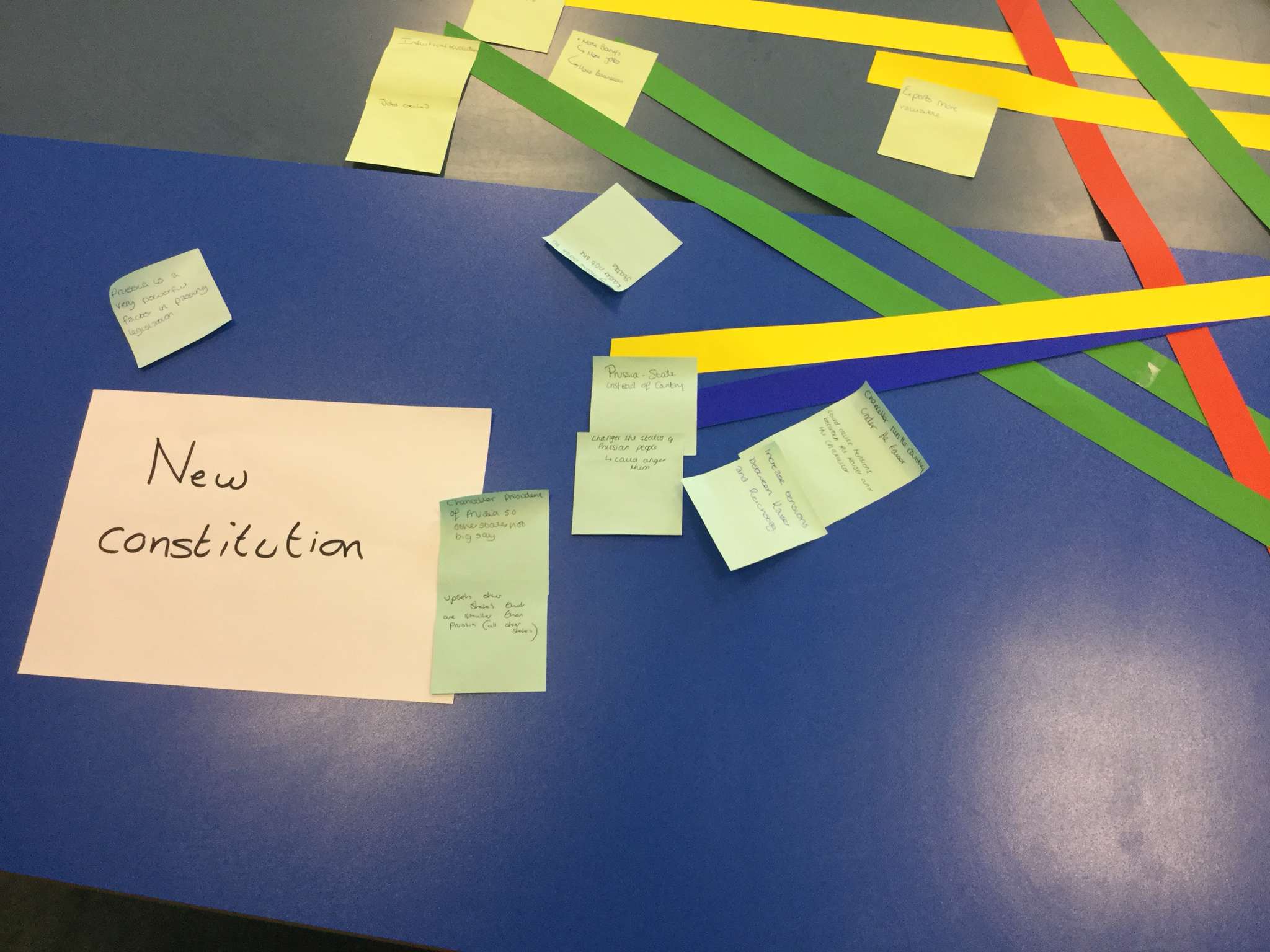
I was quite pleased with today's year 12 lesson. We were looking at the huge number of changes in Germany between 1870 and 1914. In 4 pairs, I gave them 4 big changes - new federal structure, new constitution, economic expansion, population growth - and a set of post it notes. They had 2 minutes to think of as many changes as they could which resulted from their big change. They put each change on a separate post it note. After 2 minutes they rotated groups and either added more changes on fresh post it notes, or added a change to a change - attaching a post it note to another post it note. They then rotated around until they had looked at each change.

They then moved their original big change and post it notes to a big table and arranged them in 4 areas. I gave each pair some coloured strips of paper and asked them to make links or chains between different changes.

We then sat around the table discussing what they saw. They were able to talk about most significant changes, long and short term change, which changes would cause tensions an how German people might feel faced with so many changes.

I was really impressed by the depth of their discussion and the level at which they were thinking about the effects of change. This activity really helped them to appreciate the complexity of change and how effects link together.

I then asked them to do their own version of this diagram. This was unexpectedly effective as they approached it in so many different ways. Some produced colourful versions of it, one did a mind map and one of my mathematicians decided on a vent diagram to show how so many changes overlapped. The next step will be to compare the diagrams to see how they differ and then get them to do a piece of writing based on what were the main tensions in Wilhelmine Germany. Not bad for 5 days from the end of the school year


Saturday, 11 July 2015

Ten Keys to a great lesson

I have been working on this as guide to give to staff in September. It is still a work in progress so feedback would be great


Ten key non-negotiables. This is the least our students and any visitors to our classrooms should expect


1. Student Place. In the blue folder, up-to-date and clearly annotated to show Pupil Premium students, why they are PP, target grade and current working grade. It should clearly be a working document


2. Feedback and use of DIRT. Students work should be marked at least every 3 lessons. The marking and feedback should be subject-specific and designed to help the student move forward. DIRT activities should be clearly labelled and it should be clear when and how the student has attempted to improve their work


3. Progress over time - make sure there is evidence available to show how much progress students have made over time. This could be in their existing exercise books or in previous books or folders stored in the classroom. This should be designed to primarily show the student how much progress they have made in this subject and what they are aiming for


4. Appropriate range and pace of activities. There should be a variety of activities used in the lesson. Opportunities for collaborative work, teacher talk, quiet independent study. It is the teachers responsibility to make sure there is the right balance between activities. Every 20 minutes at most - ask yourself is this still the right activity?


5. Challenge. Activities should be differentiated so that every student is stretched to achieve more in the lesson


6. Variety of student interactions. During the lesson students should have the opportunity to interact with the teacher directly and with each other, in pairs or in groups


7. Learning checked and assessed. Think about how you will check and assess how much students have learned during the lesson.


8. Homework set and used effectively. All staff and students will be using Show My Homework. If homework is due in this lesson- when will it be collected? If homework is to be set this lesson - when will it be on Show My Homework?


9. High quality presentation of work. The quality of students' presentation of work is an indicator of their attitude to the subject and their learning. Set high standards of presentation for all work done in folders or exercise books. Model the standard expected by giving students high quality resources - sheets, PowerPoints - to work with. This high quality is an indication of all of our high expectations and aspirations.


10. Active engagement. All students should be engaged in the lesson. Keep looking for students who have drifted away - how will you re-engage them?


Wednesday, 8 July 2015

Starting early


I had an idea that may make me very unpopular with some staff and some students - starting year 12 early. We work year 11 like crazy and get them, hopefully finely tuned and firing on all cylinders by the end of May - and then give them 3 months off. 3 months in which they do recharge batteries, but also get out of good habits, get bored, get lazy and get used to being lazy.

So my idea is to bring them in for 3 weeks in mid-June to early July. Use teachers year13 timetable to provide the teaching slots, build in some team-building, study skill activities and teach some if the background stuff to A Level history that is vitally important but takes up time in September.

The members of CLT I have spoken to like it so I now have to get it through a few more people but it might give students a chance to try out some courses, allow us to set more meaningful summer assignments and convince those who see school sixth-forms as too soft that we do challenge and stretch our students

Wednesday, 19 March 2014

Do we need to actually see it?

Do we need to actually see it?

I am writing this post in 2 parts and will post it on line some time in the next couple of days. Right now it is 10:56 local time on Tuesday 18 March and I am sitting on a coach outside Krakow Airport. In a little while we will be at Auschwitz-Birkenau concentration camp. I am on a 1-day trip with 2 yr12 students as part of the a Lessons From Auschwitz project. At 47 years old I have just had my first plane flight and, apart from 6 hours in France 20 years ago, this is my first trip abroad.
As a History teacher I have taught about the Holocaust for many years and found it to be one of the most intersting topics of the year. Unlike many history teachers I have not done many trips - a few local castles or 1-day trips to the Black Country Museum, but I have never done the Battlefields or Auschwitz before. I have always had mixed feelings about them. I have always felt that I can understand the horrors of the Somme or Auschwitz without actually being there - or was that my excuse for not going through the laborious, time consuming and stressful experience of organising the trip?
Today will give me the answer. I am excited, curious and apprehensive all at the same time. Later on during the day I will record my feelings - now it is time to catch up with a bit of sleep. 2:45 am is a very early start.

So now it is 7:52pm GMT and I am on the plane back home. How do you describe today? I know it will be the first thing colleagues and students will ask tomorrow - how was it? Right now I'm not sure what to say. I know Auschwitz will play with my emotions for the next few days. Auschwitz is a full- on assault on the senses. Every time you see, hear or feel something awful you turn a corner and get ht by something else.
Auschwitz was nothing like I imagined. In my head I had always pictured it as somewhere remote and isolated but it us in the middle of a town surrounded by roads, shops and residential areas. How could such unbelievable inhumanity go on so close to where people were eating, shopping and living relatively normal lives? At times Auschwitz felt a bit too much of a tourist attraction. The guides are good but moved us around at such a pace it was overwhelming. Often I wanted to stop and look longer at particular exhibits or reflect on what was there but the next group was always hot on your heels. There were points though that will stay with me and haunt me: the heartbreaking piles of hair and shoes, the luggage so carefully, lovingly, proudly labelled but with no hope of ever being returned, one long corridor with cells leading off but hundreds of photographs of victims silently watching us and we walked the corridors where they died and of course the gas chamber itself. It is so hard right now to describe how it felt to walk in and, more poignantly walk out of there.
But for me Auschitz II - Birkenau was more horrific, heartbreaking and impactful. The sheer size of the site, the mind-boggling absurdity of there being a football pitch there and walking along the 'Road to Heaven' - the route that thousands took to the gas chamber. I will never forget the powerful, heart-rending service we all took part in near the memorial in the shadow of the ruins of the gas chamber. We all lit candles and placed them on the memorial or on the train track - a symbol of hope, memory and defiance.
So - do we all need to go to places like Auschwitz? No - it is perfectly possible to have a strong, powerful response to and understanding of the Holocaust without ever leaving the classroom. But - if you do go, it will change your life. Auschwitz will now always be a part of me now. Every time I teach it I will think of today and how it affected me.
The Holocaust Educational Trust do a staggering job. They are making sure that young people not only know about Auschwitz but will tell others about it. I am 47 years old. I have another 21 years ahead of me in teaching. I have to keep teaching now. I have to tell more children about this. If I don't then I am letting down the ghosts I saw and felt today.


- Posted using BlogPress from my iPad

Sunday, 8 December 2013

Structured Collaboration

Two weeks ago I attended an INSET day on Kagan structures. I wrote then that I had been impressed and was keen to try out some of the strategies. I have always been a huge fan of collaborative learning but have been bowled over by the improvement these strategies have made to the quality of the students' learning.
The main strategies I have used have been Rally Robin, Timed Pair Share and Write Rally Robin. All of these are similar to strategies I have used in the past but the structure here forces students to play a full part in the whole process rather than let someone else do all the work.
Rally Robin - students take it in turns to say word on a topic is a great starter and surprisingly hard. On most occasions I have played too and I would recommend always trying to get involved in all the collaborative games you are playing.
Timed Pair Share I really like as students have 30 seconds to talk about something to their partner - their partner then paraphrases what they said. This is great for reinforcement and making the partner actually pay attention. I have thrown in a variation where the partner has to add something the speaker forgot. I find you need some variations to the formula to keep the kids on their toes.
Write Rally Robin is a brilliant way to build and develop the ideas students produce in groups. Students have a few minutes to work on a task. They then feedback to the group or the whole class - the other students tick it off if they thought of it and add it if they hadn't - a great way to make sure they all are involved.
I have used these techniques with all groups but they have been particularly successful with my Sixth Form groups. My year 13 group is only 4 students who are all naturally quiet so this has really helped structure and develop their discussion.
I am very impressed at how some really simple extra touches have made such a difference to my lessons. Looks like I may be adding the Kagan book to my Xmas wish list. At the INSET session some teachers were a bit skeptical and thought this was all too simplistic and silly. I hope they give these ideas a try - I am glad I did.


- Posted using BlogPress from my iPad
Saturday, 23 November 2013

Long week and new ideas

That was a really hard and long week. Lots of late meetings, Sixth Form open evening, after-school revision sessions and an INSET session. I wonder if there is any other job quite like teaching for throwing those kind of crazy weeks at you and knowing that next week will only be slightly less intense.
My lessons this week have been ok - not my best but some unexpected high points. A year 13 lesson on Germany in 1919 developed into an in-depth discussion of the merits and faults of democracy with the students showing admirable insight and perception.
The real highlight for me was an INSET day led by Elaine Brown from T2Tuk on Kagan Structures. I have to admit to being a little sceptical going in to this. I am a huge advocate of collaborative learning and students work in pairs, threes or other groups in virtually every lesson I teach. Rather arrogantly I went into the day thinking I had probably seen most of what would be presented. I was wrong. Whilst some of the ideas and techniques are already in my toolkit, most were slightly different or completely new. More importantly the ones that were slightly different were better than what I already do.
On Monday I will definitely be using Rally Robin, Timed Pair Share and Write Round Robin. I also appreciated that the presenter took the time to explain the psychology and pedagogy around the techniques she was using. This was more than just a bag of tips session.
It is testament to the quality of the session that at the end of a manic week I felt inspired and looking forward to Monday's lesson.
One other thing did strike me this week and that is that I am now being seen by others as a 'veteran' - and I think that scares me. I realised on Monday that on our College Leadership Team there are only 2 of us who had experience of teaching pre National Curriculum. During Friday' INSET one way of randomising groups was to create a line of experience. We had to arrange ourselves in a line around the room based on number of years teaching x number of schools worked in. Out of 100 people only 3 had a higher number than me - 23 years x 5 schools = 115. The only consolation is that in Gravity the role of the veteran is played by George Clooney - at last we have something in common.
Roll on next week


- Posted using BlogPress from my iPad

Saturday, 16 November 2013

Open Invites and the best test of the year

Some real highlights this week. My Year 11s are currently preparing for their Controlled Assessment on the Civil Rights Movement in the USA. Whilst trawling through the internet last weekend (a poor excuse for not really doing any work) I cam across a fantastic resource - a scan of the literacy test used in Louisiana in the 1960s to stop black people from registering to vote. I typed it up so it looked a bit more like the kind of test they are used to and gave them it cold at the beginning of the lesson. They had 10 minutes to complete it and had to get all 23 questions right to pass. Every single student failed including several who are targeted A*. The best thing was how annoyed they were at the test - the questions weren't that hard but they were badly worded, vague and in some cases - just weird. This is just one example:

15. In the space below, write the word "noise" backwards and place a dot over what would be its second letter should it have been written forwards

And it was fascinating to see how many got "spell backwards, forwards" wrong.
The test was great for helping students to understand why so few blacks were registered to vote in the 1960s.

This week I have introduced a new idea at school called Open Invites - asking staff to nominate some of their lessons where they are happy for anyone to pop in and observe for 15 minutes. Three of us volunteered lessons this week and several teachers popped in. I have to admit it really made me raise my game knowing that anytime someone could appear and expect to see something good - like OFSTED but without the fear. The lessons that were observed went well and I got some good useful feedback. The next step is to persuade more staff to offer up invites and to give up a bit of time to go and watch.

I also got back into podcasts this week by putting some revision podcasts on Emdodo for year 11 (and 25/39 turned up for revision lesson on Wednesday - hurray!). Year 13 also recorded their own podcasts on the effect of World War One on Germany. I am now thinking about doing some video podcasts on YouTube if I can find a few minutes.

Busy week coming up - looking forward to leading an INSET session on Assessment, marking and feedback on Wednesday, looking at how the Nazis used emotion to gain support and attending an INSET day on Kagan structures on Friday.

And I managed to blog two weeks in a row :)


- Posted using BlogPress from my iPad